Building materials are required for a wide range of construction work including carpentry, roofing, structural reinforcement, insulation, and plumbing. The particle size and particle shape of the raw materials influence quality and performance of the end product, and therefore require quality control by particle characterization. Microtrac analyzers are successfully used to determine the size and shape of various building materials.
Building materials range from naturally occurring substances such as rock, clay, sand, and wood to synthetic polymers and multiple combinations of both (composites). Concrete or mortar are for example mixtures of cement and aggregates like sand or gravel.
Shorter measurement time. Better optical resolution. More frames per second.
The CAMSIZER X2+ is one of the most powerful, extremely versatile particle size and shape analyzers with a wide measuring range that combines state-of-the-art camera technology with flexible dispersion options. Based on the principle of Dynamic Image Analysis (ISO 13322-2), the CAMSIZER X2+ provides precise particle size and shape information of powders, granules and suspensions in a measuring range from 0.9 μm to 8 mm.
The CAMSIZER X2+ produces a particle flow which is characterized by an optical system with high resolution. An ultrabright LED stroboscopic light sources and two high-resolution digital cameras achieve a frame rate of more than 420 images per second which are evaluated in real time by a powerful software. Thus, the CAMSIZER X2+ captures the images of hundreds of thousands to several millions of particles with highest accuracy within only 1 to 3 minutes.
The CAMSIZER X2+ provides a wide selection of particle information which allows for comprehensive and reliable characterization of the sample material. It is suitable for use in R&D as well as for routine tasks in quality control.
In most cases the particle size distribution of sand used in building materials is analyzed by sieve analysis. Microtrac's CAMSIZER series can replace this time-consuming and error-prone technique with a quicker, more reliable method that provides a higher resolution of particle size results as well as additional particle shape information.
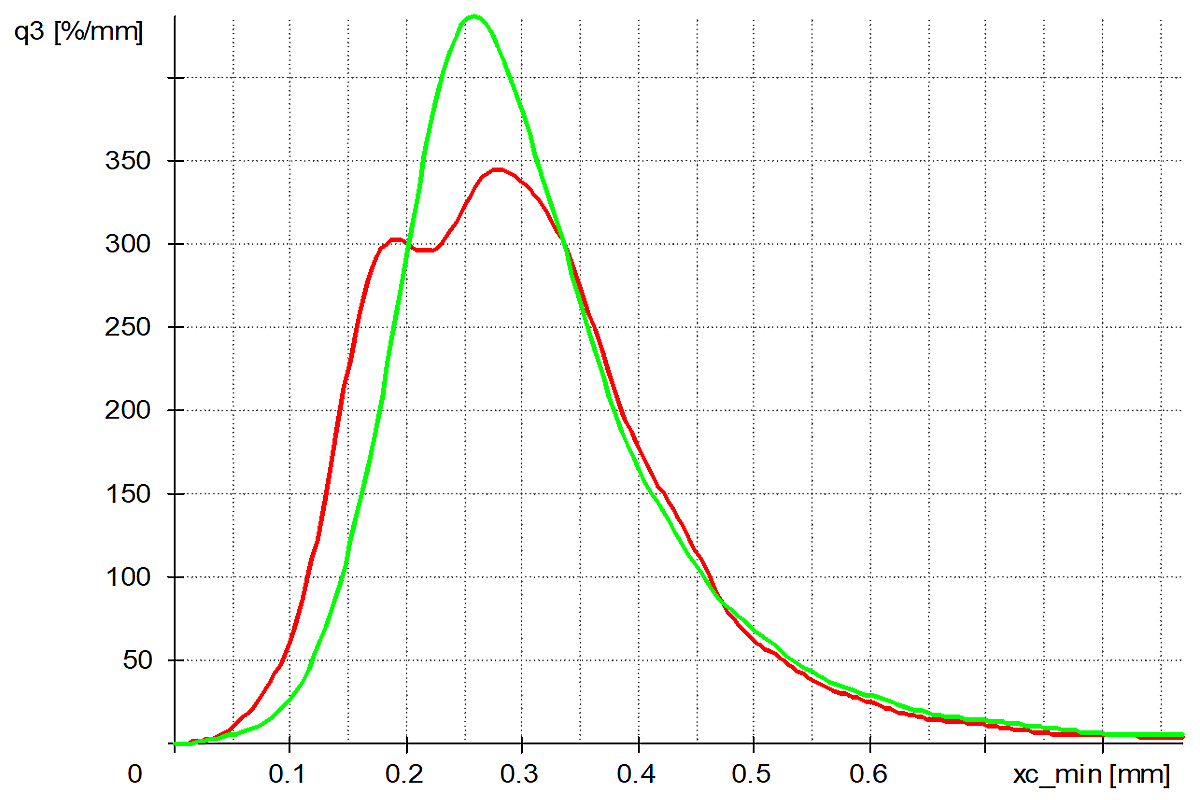
Dos tipos de arena extraídos en diferentes ubicaciones y medidos con el CAMSIZER X2. Esta arena se utiliza como revestimiento en tuberías de plástico reforzado con fibra de vidrio para aumentar su rigidez. El parámetro de tamaño presentado es "xc mín." (ancho de partícula). La curva roja es ligeramente bimodal. La arena con una amplia distribución de tamaño puede compactarse más en el núcleo de la tubería, lo que proporciona al producto final una mayor estabilidad.
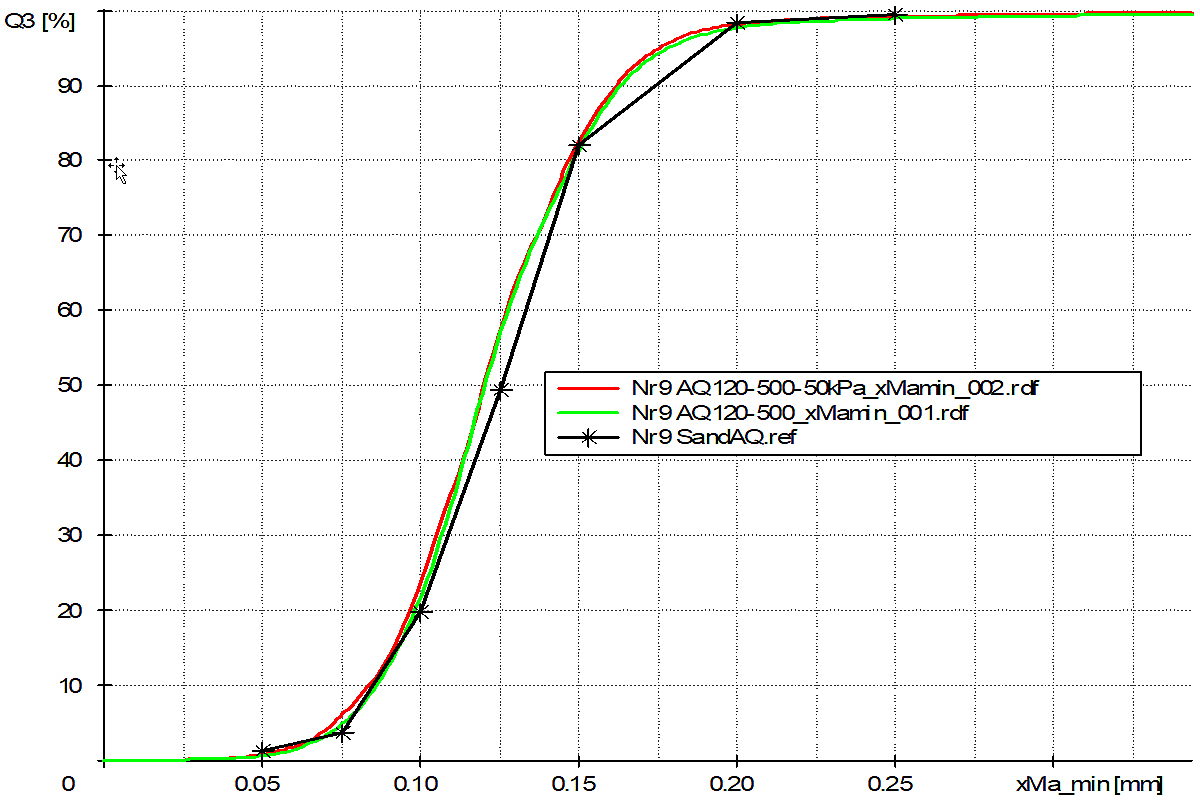
One sand sample that was measured by sieving (black) and by the CAMSIZER X2 using two different dispersion modules: the X-Fall module (green) and the X-Jet module (red). The results compare extremely well, proving that CAMSIZER X2 can match existing sieve analysis results. Hence, product specifications based on sieve analysis can remain unchanged when transitioning to a CAMSIZER system.
Limestone (calcium carbonate) is a raw material used in many products.
The particle shape distribution results for the same collection of limestone samples. The reported shape parameter is sphericity, defined as: sphericity = 4 p A/ P2 where "A = Area of the particle projection" and "P = Perimeter length of the particle projection". The least round sample is Nr 6 (red), while the most round sample is Nr 4 (light blue).
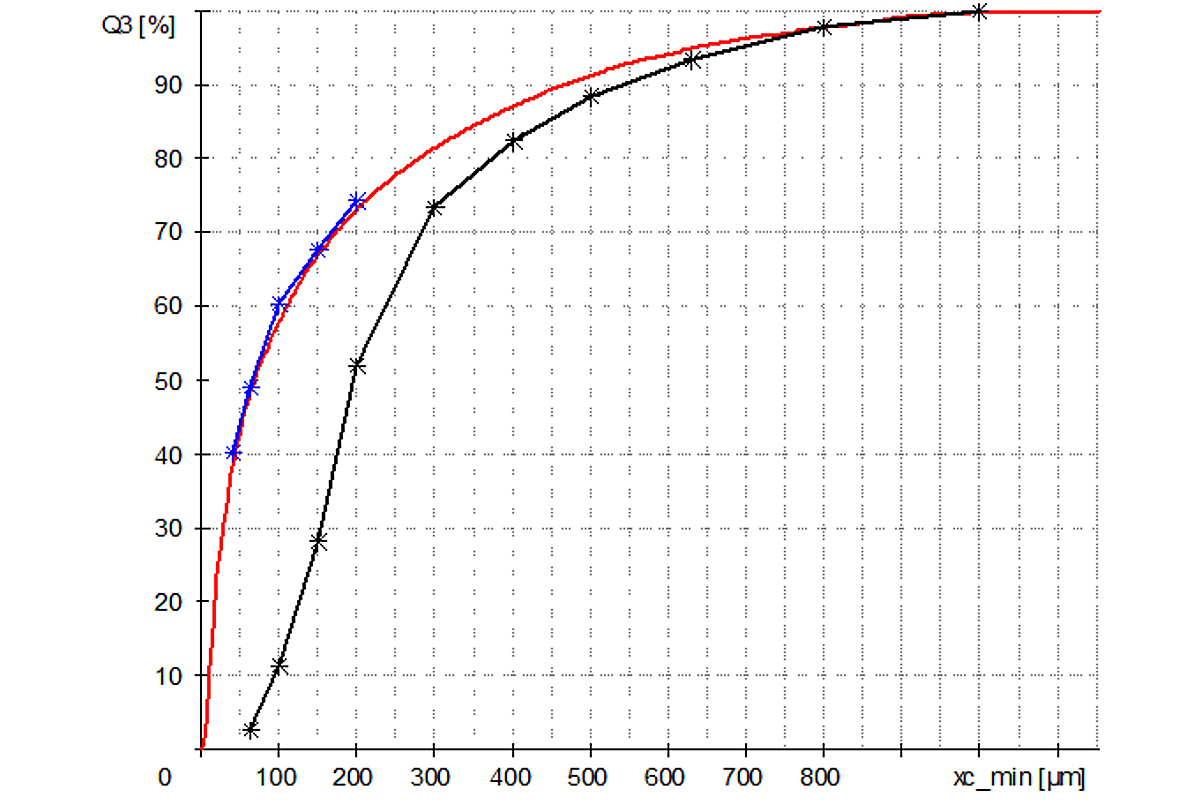
Typical result from a particle size analysis of a plaster sample. The size range is fairly wide, ranging from 2 microns to about 1 mm. The graph shows the result of the CAMSIZER X2 in X-Jet mode, measured with a dispersion pressure of 150 kPa (red curve).
The plaster particles are agglomerating and “sticky”, thus the results of a conventional sieve analysis shows much coarser data (black curve), especially for the fine particles. However, if the particles are dispersed properly with an air jet sieve (AS 200 jet, blue curve), the results agree perfectly with the CAMSIZER X2.
Save and reliable detection of oversized particles are among the most important objectives of particle size analyis. For this purpose, Dynamic Image Analysis with the CAMSIZER X2 is the most powerful technique with unmatched accuracy.
Figure 6 shows a silicate sample that was analyzed with the CAMSIZER X2 using the X-Fall module. First, the original sample was measured and the size distribution was found to range from 5 μm to 100 μm (red curve). Then, 0.1 % of oversized (> 100 μm) particles were added and the sample was analyzed again (green curve). Finally, the experiment was repeated with 1 % oversize added (blue curve).
This silicate is used as raw material for the coating of tiles and oversized particles will result in a rough and uneven surface of the finished tile. The CAMSIZER X2 reliably detects the correct amount of oversize. Note that below 100 μm, where all samples are identical, the reproducibility is excellent!