






Pore size distribution is an important parameter for characterizing porous materials, as it influences properties such as adsorption capacity, permeability, reactivity, and mechanical performance. Several measurement techniques are available to determine pore size and pore volume, each covering different pore size ranges and providing specific information about the pore structure. The most widely used methods include gas adsorption and mercury intrusion porosimetry.
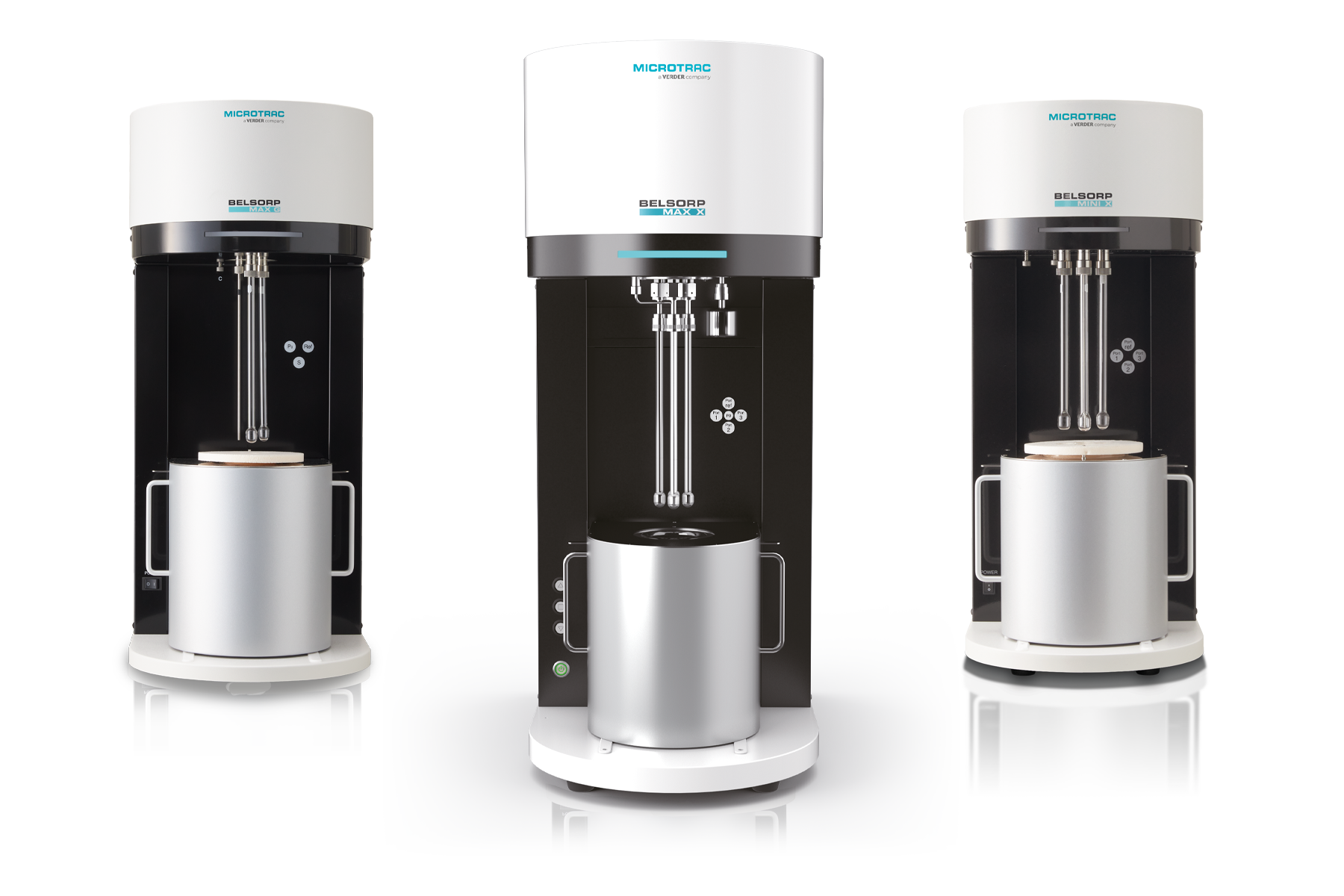
MICROTRACでは、ガス吸着測定に関する幅広い製品ラインナップを提供しています。
Understanding Pore Size Distribution
Pore size distribution describes how the pore volume of a material is distributed across different pore sizes. According to the IUPAC classification, pores are divided into three categories:
- Micropores: Smaller than 2 nm
- Mesopores: Between 2 and 50 nm
- Macropores: Larger than 50 nm
Determination of Pore Size Distribution
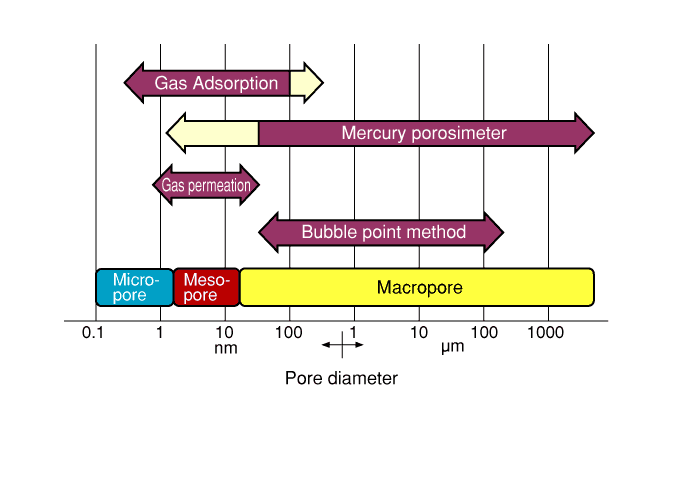
Comparison of pore size distribution measurement methods and their applicable pore size ranges.
Methods for Measuring Pore Size Distribution
Pore size distribution is an important parameter for characterizing porous materials, as it influences properties such as adsorption capacity, permeability, reactivity, and mechanical performance. Several measurement techniques are available to determine pore size and pore volume, each covering different pore size ranges and providing specific information about the pore structure. The most widely used methods include gas adsorption and mercury intrusion porosimetry.
Gas adsorption is particularly suitable for analyzing micropores and mesopores. The method measures the amount of gas adsorbed by a material at different relative pressures, typically using nitrogen at 77 K or argon at 87 K.
The resulting adsorption isotherm is evaluated using models such as BJH, NLDFT, or GCMC to determine pore size distribution and pore volume. Gas adsorption can characterize pores from the molecular scale to approximately 100 nm, although the practical upper limit depends on measurement conditions and accuracy requirements.
Mercury intrusion porosimetry determines pore size distribution by applying pressure to force non-wetting mercury into accessible pores. The relationship between intrusion pressure and pore diameter is described by the Washburn equation.
This technique is especially useful for characterizing mesopores and macropores, covering a broad measurement range extending into the micrometer scale. However, high pressures may affect sensitive materials, and the measured pore sizes can be influenced by narrow pore entrances and interconnected pore structures.
Capillary flow porometry, including bubble point measurements, is primarily used to characterize through-pores in filters and separation membranes. By measuring the gas pressure required to displace a wetting liquid from the pores, the method provides information about the size and distribution of accessible flow paths.
Comparison of Pore Size Distribution Measurement Methods
| 測定原理 | Main Application | Important Consideration |
|---|---|---|
| ガス吸着 | Micropores and mesopores | Evaluation model and pore accessibility |
| 水銀圧入法(水銀ポロシメトリ) | Mesopores and macropores | High pressure and pore entrance effects |
| Capillary Flow Porometry | Through-pores in filters and membranes | Only connected flow paths are characterized |
Choosing the Appropriate Measurement Method
The selection of a suitable method depends on the expected pore size range, material properties, and intended application. Gas adsorption provides detailed information about smaller pores, while mercury intrusion porosimetry is particularly useful for larger pore structures. Capillary flow porometry is suited to applications where through-pore size is critical.
Because these methods are based on different physical principles, their results are not always directly comparable. Factors such as pore accessibility, pore geometry, sample preparation, and the selected evaluation model must be considered when interpreting pore size distribution data.
Further Information on Pore Size Analysis
For more detailed information on pore characterization and evaluation methods, explore the following topics in our Knowledge Base:
- Micropore Analysis
- Mesopore and Macropore Analysis
- NLDFT / GCMC Method
Pore Size Distribution Analyzers from MICROTRAC
MICROTRAC offers a wide range of instruments for gas adsorption measurement and pore size distribution analysis, providing reliable solutions for research, material development, and quality control.




お見積もりにご興味がある場合、または詳細な情報が必要な場合は、お問い合わせください。
MICROTRACの測定装置が使用されている様々なアプリケーション分野をご覧ください。
More about MICROTRAC'S technology and tried-and-true measurement methods.
Take a look at our application laboratory and measurement service.