





If you are involved in the formulation of pigments, powder coatings, and inks, you might have questioned the following:
- How does diluting the pigment or ink emulsion impact particle interactions?
- Will there be any effects of agglomeration or flocculation?
- Are the zeta potential values still reliable to determine stability after diluting the solution?
- How do pH and conductivity values affect the samples?
- What is the exact amount of titrant required to create a stable formulation?
Le tecniche di Additive Manufacturing sono di grande interesse soprattutto nella costruzione di aeromobili. La stampa 3D metallica apre possibilità completamente nuove per la riduzione del peso e, di conseguenza, per la riduzione del consumo di cherosene. Le parti che prima dovevano essere assemblate da dozzine di singoli componenti ora possono essere prodotte direttamente in un unico pezzo. I progressi nello sviluppo dell'Additive Manufacturing consentono di produrre sempre più parti in grandi quantità mediante la stampa 3D.
Le polveri utilizzate per la produzione additiva devono soddisfare i più elevati standard di qualità: la distribuzione delle dimensioni deve essere ristretta e deve essere conosciuta nel modo più preciso possibile per controllare il comportamento del materiale durante il processo di sinterizzazione.
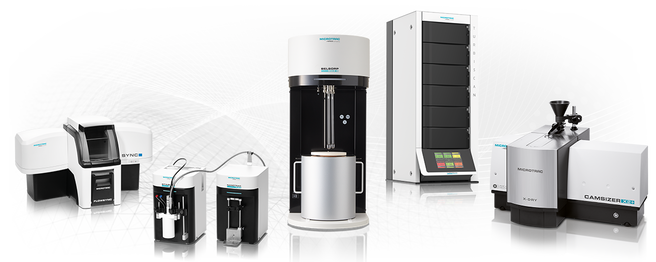
Microtrac offre prodotti per tutte le tecnologie di Analisi Granulometrica.
ASTM E3427-24 Standard
Standard Guide for measuring intensity, polydispersity, size, zeta potential, molecular weight, and concentration of nanoparticles in liquid suspension using laser-amplified detection / power spectrum analysis (LAD / PSA) technology.
- Measure scarce and valuable samples as small as 2 microliters – at full strength
- Measure at concentrations as high as 40 cubic centimeters per milliliter
- No interference from dust or large contaminants
- No need for dilution of inks, paints, or polystyrene standards to avoid changing ionic strength of the sample

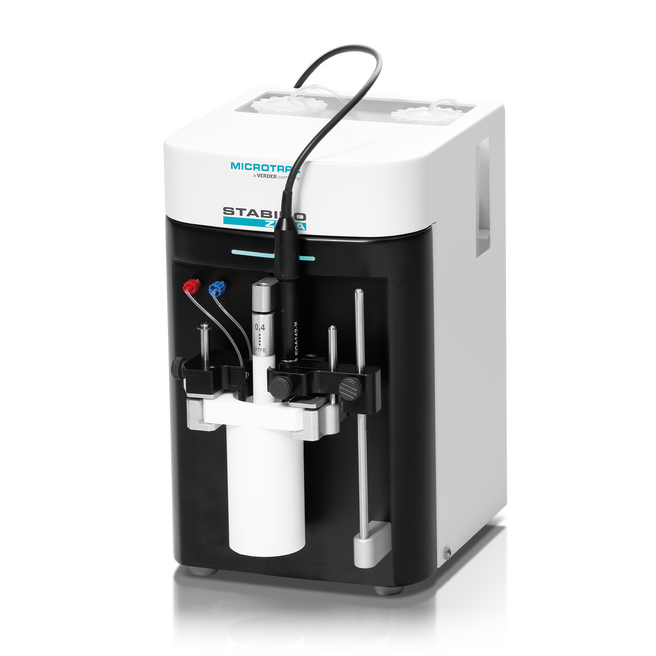
Microtrac’s NANOTRAC FLEX and STABINO ZETA utilize unique technologies that can measure your samples undiluted or at higher concentrations.
- The STABINO ZETA is the preferred choice for accurately determining zeta potential and colloidal stability
- It can perform fast titrations and replace classical zeta potential measurement
- Particle surface charge and interface potentials like the zeta potential and streaming potential are commonly used to characterize the stability of suspensions, emulsions, and nanoparticles
The Perfect Solution for Pigments & Inks
- Simultaneous determination of 5 measurement parameters within a few seconds:
- Zeta potential, streaming potential, conductivity, pH value, temperature
- Particle size as an additional parameter when combined with the NANOTRAC FLEX
- Mix and Measure principal without prior knowledge
- Innovative probe design enables measurement over a wide concentration range
- STABINO ZETA software allows for real-time monitoring of your measurement
- Sample volume: 1 ml, 10 ml
Interested? Contact us for free sample evaluations, instrument demonstration or for a quotation!
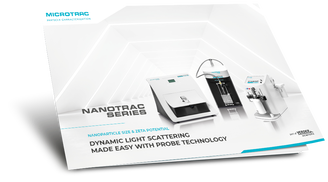
Want to know more? Click on the image to take a look at our extensive brochure for our DLS portfolio, of which we will gladly send you a high-quality print version. Or discover the many different areas in which Microtrac's DLS particle analyzers are used by checking out our numerous application notes. In addition, we offer a comprehensive insight into the DLS methodology, which you can access through our Knowledge Base.