






Dynamic Light Scattering Principle and Particle Size Analysis
Dynamic light scattering (DLS) measures the hydrodynamic diameter of nanoparticles, colloids, emulsion droplets, and macromolecules dispersed in liquids. MICROTRAC, a Verder Scientific brand, applies the technique in NANOTRAC analyzers for laboratory, at-line, and in-line particle size analysis.
0.3 nm–10 µm
Measuring range (particle size); most suitable range 1 nm–2 µm
≈ 2 µL
Minimum sample volume: 1 drop
30–180 s
Recommended minimum measurement duration, depending on particle size
Key figures of dynamic light scattering
| Parameter | Value |
|---|---|
| Measuring range (particle size) | 0.3 nm–10 µm; most suitable range 1 nm–2 µm |
| Sample concentration | From a few ppm to 40 vol% (sample dependent) |
| Minimum sample volume | 1 drop (approximately 2 µL) |
| Measurement time | Recommended minimum duration: 30–180 s, depending on particle size |
| Additional parameters | Primary DLS result: particle size. NANOTRAC-specific functions: particle concentration and molecular weight; zeta potential requires a complementary measurement technique. |
| Standards | ISO 22412 (dynamic light scattering), ISO 13099-2 (zeta potential) |
✓ Heterodyne detection with an optical probe: many samples can be measured at or near their original concentration, reducing or eliminating dilution
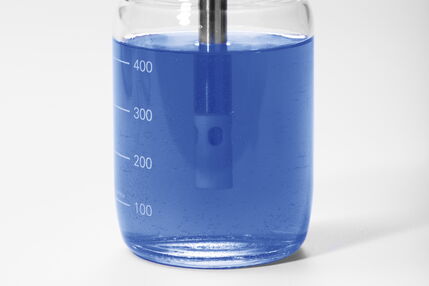
✓ Immersion probe for sample volumes from a single drop to a process line (at-line and in-line)
✓ Particle size by DLS, with particle concentration and molecular weight functions available on NANOTRAC analyzers
01 · Measuring principle
Principle of dynamic light scattering
What is dynamic light scattering?
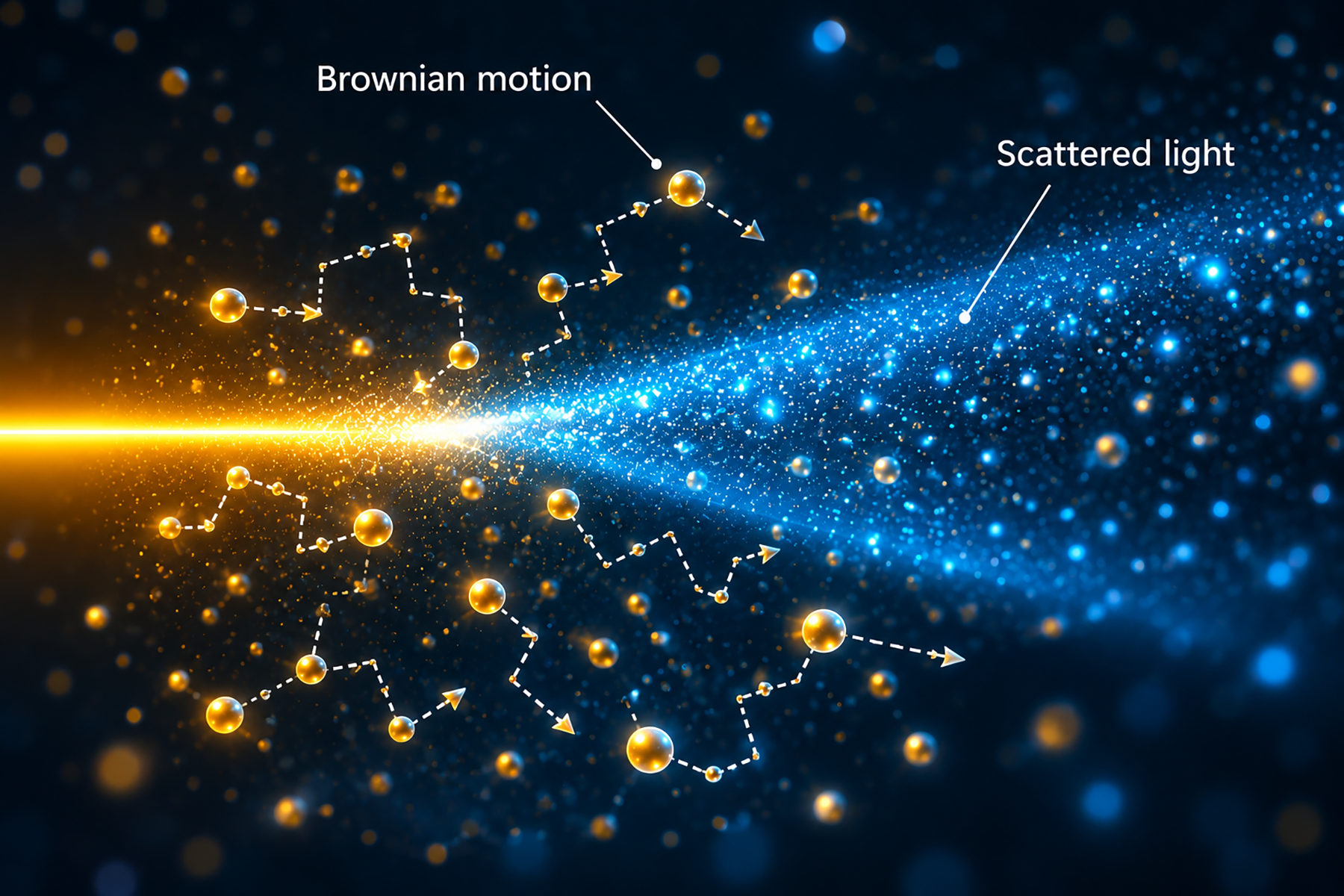
Dynamic light scattering (DLS) is a method for measuring the size of particles dispersed in a liquid. DLS records how fast the particles move by Brownian motion and calculates the hydrodynamic diameter from this speed. Small particles move faster than large particles. The method is described in ISO 22412.
Brownian motion is the random movement of particles caused by collisions with molecules of the surrounding liquid. The diffusion coefficient describes this movement. Dynamic light scattering is particularly suitable for nanoparticles smaller than 100 nm. It also measures colloids, which typically range from 1 nm to 1,000 nm.
How does dynamic light scattering determine particle size?
A laser illuminates the sample, and a detector records the light scattered by the particles at a fixed angle. Because the particles move relative to each other, the intensity of the scattered light fluctuates over time. The analysis of these fluctuations gives the diffusion coefficient. The Stokes–Einstein equation converts the diffusion coefficient into the hydrodynamic diameter.
Stokes–Einstein equation
dh Hydrodynamic diameter
η Dynamic viscosity of the dispersion medium in mPa·s
kB Boltzmann constant
D Diffusion coefficient
T Absolute temperature in K
The equation defines three measurement conditions. Temperature must be measured or controlled because the diffusion coefficient increases with temperature. The viscosity of the pure dispersion medium must be known. A viscosity error by a factor of two causes a particle size error by the same factor. Particles must move freely, so the sample must remain at rest and particle interactions must not restrict diffusion. The equation assumes spherical particles in a Newtonian liquid, which applies to most liquids below 20 mPa·s.