






Toners are colorants for electrostatic printing processes. Toner is a very fine powder consisting of 5 to 30 μm particles. Due to the very small particle size, the powder is flowable and behaves like a liquid. Toner is composed of synthetic resin, pigments, magnetizable metal oxides and various auxiliary substances.
Toners are mainly used in photocopying machines and laser printers to create a print image on paper. Laser toner cartridges for use in copiers and printers come in sets of cyan, magenta, yellow and black (CMYK), allowing a very large variety of colors to be generated by mixing (Fig. 1).
The demands placed on the toner are very high: On the one hand, it must meet the requirements with regard to the printing result, on the other hand, the toner should adhere to as many materials as possible, except for the device itself (fixing rollers). Furthermore, it must meet the technical requirements of the device, must not accept moisture and must remain consistent in its consistency until use.
To ensure these consistent material properties, precise characterization of particle size and particle shape with an according particle analyzer is crucial.
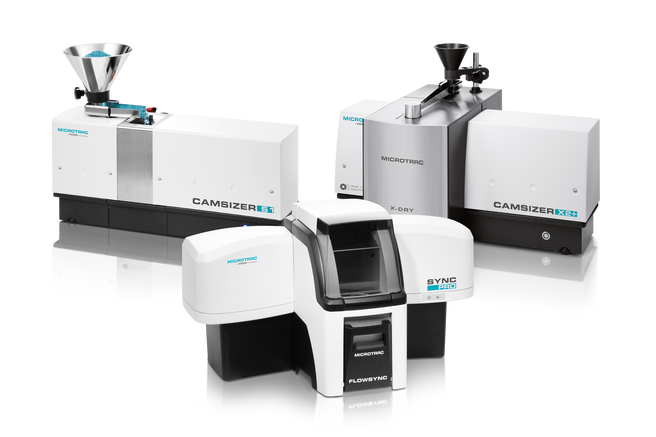
A Microtrac cég dinamikus képfeldolgozás elvén működő többféle analizátort is kínál.
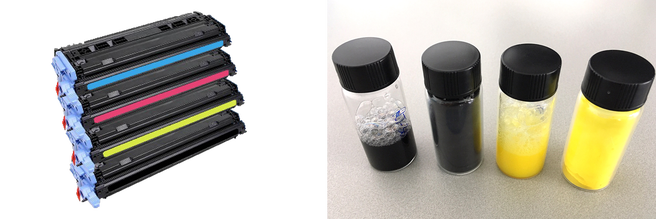
Ábra # 1:
Left: Typical toner cartridges for use in laser printers. Right: Toner samples submitted for analysis in a Microtrac laboratory, from left to right: black liquid, black powder, yellow liquid and yellow powder.
Megoldás Statikus képelemzés a CAMSIZER M1 készülékkel
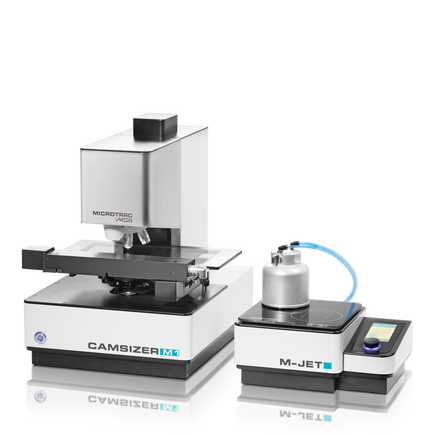
A CAMSIZER M1 a sztatikus képfeldolgozás elvét alkalmazza 0,5 μm - 1500 μm mérettartományba eső szemcsék mérete és alakja meghatározásához. Az analizátor lényegében egy fénymikroszkóp, melynek hardvere és szoftvere automatizált szemcsevizsgálatra van optimalizálva.
Sztatikus képfeldolgozás (ISO 13322-1 szerint) esetén a tárgylemezre vagy más hordozóra felvitt mintát automatizált mozgású mikroszkópasztal lépésekben mozgatja egy 18,1 Megapixel felbontású kamera előtt, mely fényképeket készít róla. A fényképezés idején áll ("sztatikus") a minta, ez biztosítja a képek magas minőségét és részletgazdagságát.
Az akár 6 különböző nagyítású objektív és a mikroszkópasztal <3 μm helyességű pozícionálása optimális mérési körülményeket garantál a teljes méréstartományban. Az eredmények méret- és alakeloszlások formájában jelenítődnek meg számos beállítható mérési paraméterrel együtt. A Particle X-Plorer szoftverrel mindegyik lefényképezett szemcse utólag is megjeleníthető és analizálható.
For the sample preparation of dry powders, such as toner particles, the M-Jet module is available, see Fig. 2 on the right.
Sample Preparation
Black toner and yellow toner, both as powder and as suspension have been submitted for analysis (four samples altogether, Fig. 1, right). As preparation for the analysis the two suspensions, two drops each were placed on a slide and covered with a coverslip. For the undiluted samples, about 10% of the image area was covered by the particles, as a result of which many overlays were detected (Fig 3, left). The samples were therefore diluted until a covered area of 0.5 - 1% was reached. For the diluted samples, almost all particles are well separated from each other, the effect of the overlays can therefore be neglected (Fig. 3, right). The two powder-like toner samples have been dispersed on a glass slide with the M-Jet module (70 kPa pressure).
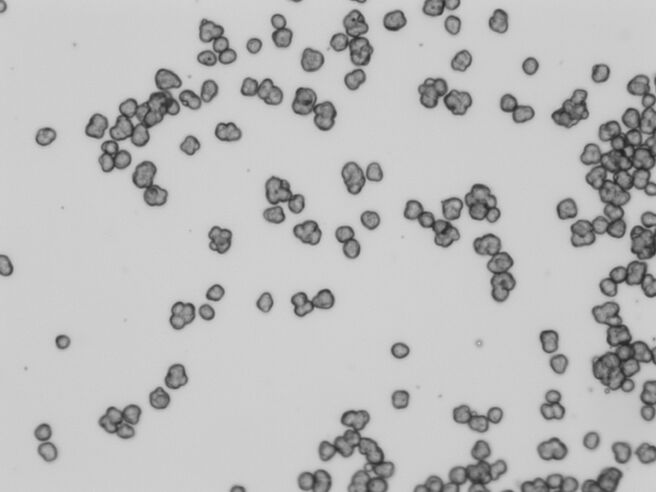
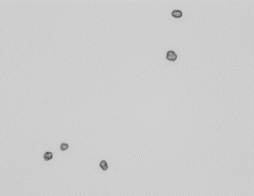
Ábra # 3:
Balra: Toner részecskék folyadékban, eredeti koncentráció -> sok agglomerátum. Jobbra: Toner részecskék folyadékban, hígítva -> a részecskék szétválnak. CAMSIZER M1 képek, 20-szoros nagyítással
A toner részecskemintákat a CAMSIZER M1 készülékkel mértük az xc min (szélesség), x area (körrel egyenértékű átmérő) és xFe max (hossz) méretmeghatározásokkal. Ezzel egyidejűleg a részecskék alakját is érzékeltük. A műszert átmenő fényre és 20-szoros nagyításra állítottuk be. További vizsgálatokat végeztek 50 x nagyítással. A méret- és alakmeghatározások részletes leírása a függelékben található.
| Analysis Time | Number of Particles | Field Size | Number of Images | |
|---|---|---|---|---|
| Yellow Liquid | 7 min 24 s | 17 737 | 15.0 x 8.8 | 1017 |
| Black Liquid | 7 min 0 s | 11 697 | 12.1 x 10.3 | 961 |
| Yellow Dry | 16 min 9 s | 41 373 | 17.1 x 18.5 | 2426 |
| Black Dry | 27 min 14 s | 30 603 | 16.3 x 35.1 | 4384 |
Table 1:
Typical measurement conditions for toner particle samples wet / dry at 20 x magnification.
Results
In the following diagrams the size distribution is expressed by:
- Cumulative distribution Q3
- Frequency distribution q3
20 x or 50 x magnification?
Fig. 4 shows a comparison between analysis at 20 x and 50 x magnification. The results are almost identical. Therefore, it is reasonable to measure with the lower magnification because this results in significantly shorter analysis time.
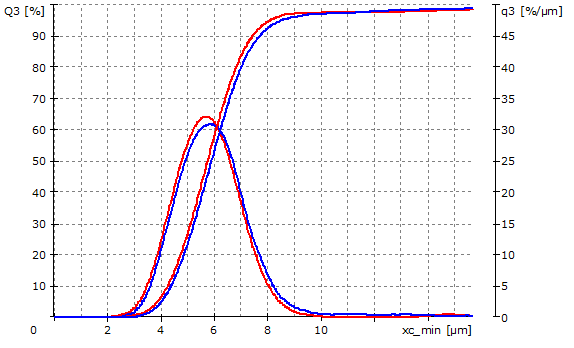
Ábra # 4:
Graphs of the black dry toner particles sample, size definition X c min. with 20 x (red) and 50 x magnification (blue).
Repeatability
The yellow liquid sample has been measured three times (Fig. 5). The repeatability of the results is excellent.
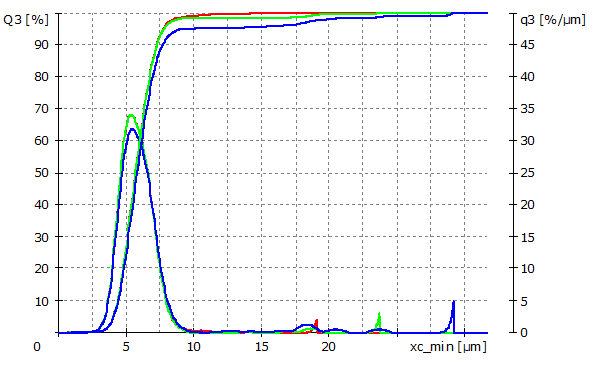
Ábra # 5:
Three consecutive measurements of the yellow toner liquid sample. Size definition xc min with magnification 20 x. First measurement: red curve, second measurement: green curve, third measurement: blue curve. Some agglomerates appear as the measurements proceed and the toner sample slowly dries (oversize particles in the third measurement).
Dry samples
Fig. 6 shows a comparison of the size distribution for the two dry powders. The black powder is slightly larger than the yellow powder.
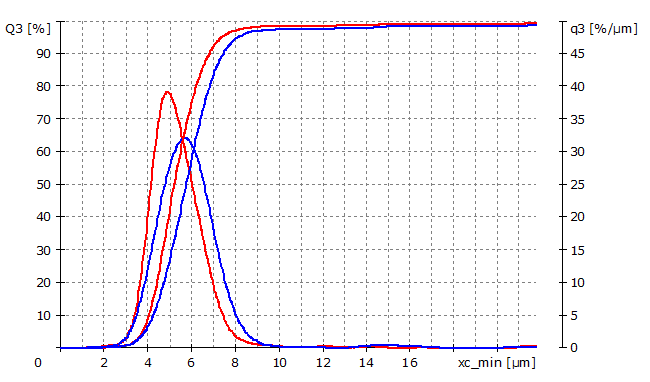
Ábra # 6:
Graphs of dry yellow toner particles sample (red) and dry black toner particles sample (blue) size definition x c min.
Liquid samples
Fig. 7 shows a comparison of the size distribution for the two dry powders. Again, the black powder is slightly larger than the yellow powder.
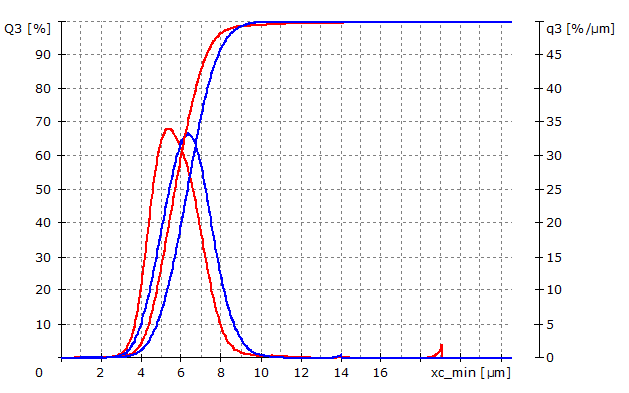
Ábra # 7:
Graphs of the liquid toner samples, size definition x c min. 20 x magnification. Yellow toner liquid sample (red) and black toner liquid sample (blue)
Particle Size results: Overview
Table 2 shows the percentiles of the Q3 distribution at 10 %, 50% and 90 % (d10, d50, d90) for all three size definitions xc min, xarea and xFe max
The results for the wet and dry measurement of each color are almost identical. It is therefore possible to measure toner in wet or dry mode. However, the concentration of the liquid must not be too high. Dry sample preparation with the M-Jet works equally well as a wet dispersion.
| xc min | Yellow Liquid | Black Liquid | Yellow Dry | Black Dry |
|---|---|---|---|---|
| D10 [µm] | 4.37 | 4.78 | 4.05 | 4.25 |
| D50 [µm] | 5.69 | 6.31 | 5.21 | 5.75 |
| D90 [µm] | 7.27 | 7.85 | 6.79 | 7.44 |
| xarea | Yellow Liquid | Black Liquid | Yellow Dry | Black Dry |
|---|---|---|---|---|
| D10 [µm] | 4.88 | 5.45 | 4.55 | 5.09 |
| D50 [µm] | 6.29 | 7.03 | 5.85 | 5.58 |
| D90 [µm] | 7.78 | 8.47 | 7.59 | 8.17 |
| xFe max | Yellow Liquid | Black Liquid | Yellow Dry | Black Dry |
|---|---|---|---|---|
| D10 [µm] | 5.09 | 5.99 | 4.70 | 5.73 |
| D50 [µm] | 6.98 | 7.91 | 6.55 | 7.61 |
| D90 [µm] | 8.81 | 9.80 | 9.12 | 9.76 |
Table 2:
d10, d50 and d90 of all four samples, 20 x magnification, size definition x c min, x area and x Fe max
Comparison with Laser Diffraction
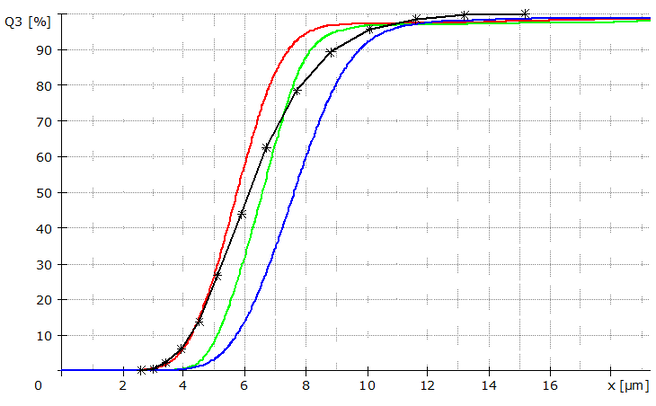
Ábra # 8:
A CAMSIZER M1 száraz fekete tonerminta grafikonjai, x c min (piros), x terület (zöld) és x Fe max (kék), valamint a lézerdiffrakció (fekete *). A lézerdiffrakcióval kapott eloszlás szélesebb, mint a CAMSIZER M1 eredménye. A lézerdiffrakció a részecskeméretet gömbmodell alapján számítja ki. Az eredmény ezért a CAMSIZER M1 szélesség- és hosszmérése között van.
Particle Shape Analysis
A toner részecskemintákat a CAMSIZER M1 készülékkel mértük az xc min (szélesség), x area (körrel egyenértékű átmérő) és xFe max (hossz) méretmeghatározásokkal. Ezzel egyidejűleg a részecskék alakját is érzékeltük. A műszert átmenő fényre és 20-szoros nagyításra állítottuk be. További vizsgálatokat végeztek 50 x nagyítással. A méret- és alakmeghatározások részletes leírása a függelékben található.
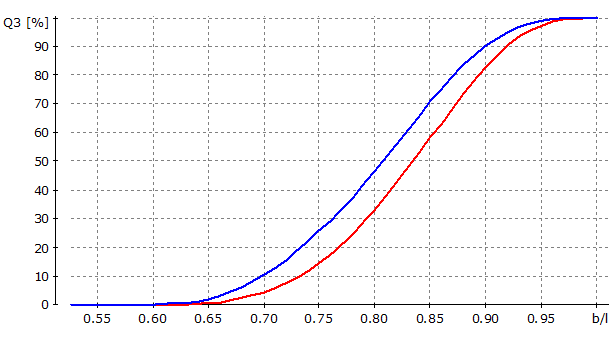
Ábra # 9:
Shape graphs of the yellow liquid toner (red) and black liquid toner (blue). Shape parameter aspect ratio (b/l); Xc min divided by xFe max.

Ábra # 10:
Shape graphs of yellow liquid toner (red) and black liquid toner (blue). Shape parameter roundness (RDNS_C).
Toner Particles Evaluation
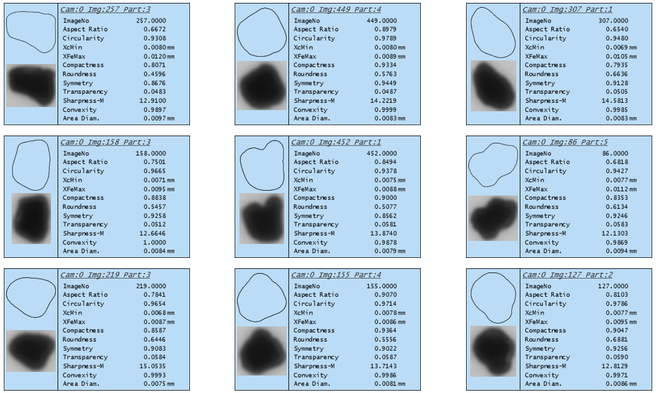
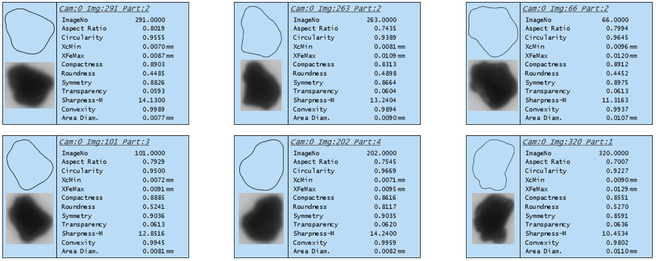
All particle images acquired during the measurement are saved and can be used for later evaluation. The Particle X-Plorer software offers many possibilities to evaluate images or individual particles. Filter options are available to browse for particles with selected characteristics. In the following, particle examples of both toner samples are presented. Note that all relevant particle size and particle shape data is displayed right next to the according image.

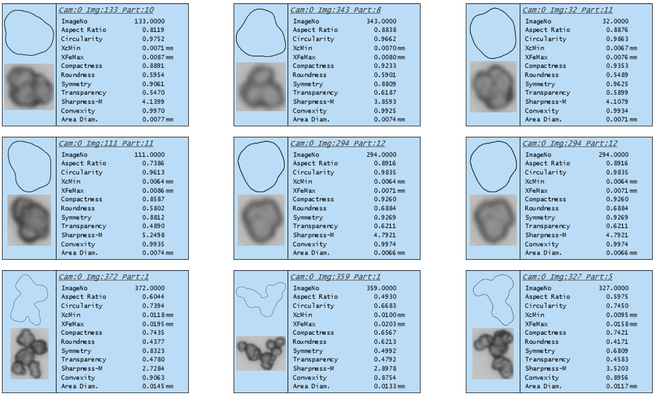
Ábra # 11:
Example images of the yellow liquid toner sample. All relevant data is displayed next to the particle image. Agglomerates (bottom row) can be easily identified by the low circularity or convexity of the particle. If required, these may be excluded from the evaluation.
Ábra # 12:
Example particles of the black liquid toner sample.
Összefoglalás
Függelék: CAMSIZER M1 részecskeméret és részecskeforma paraméterek
Függelék: Az alábbi ábrák a CAMSIZER rendszerekkel végzett képelemzés során leggyakrabban használt részecskeméret- és alakdefiníciókat mutatják.AMSIZER M1 részecskeméret- és részecskealak-paraméterek
xc min
"Width"
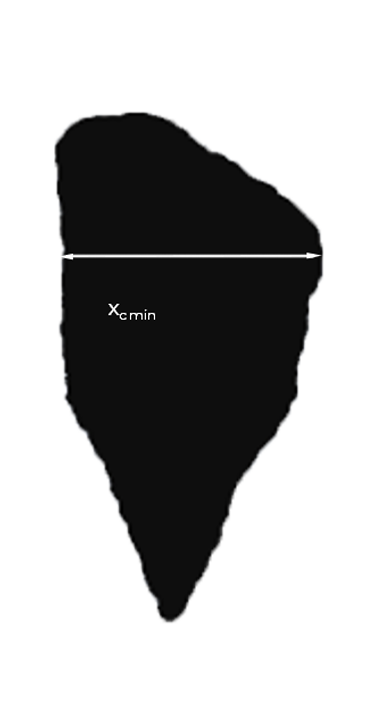
Best suited for sieve correlation
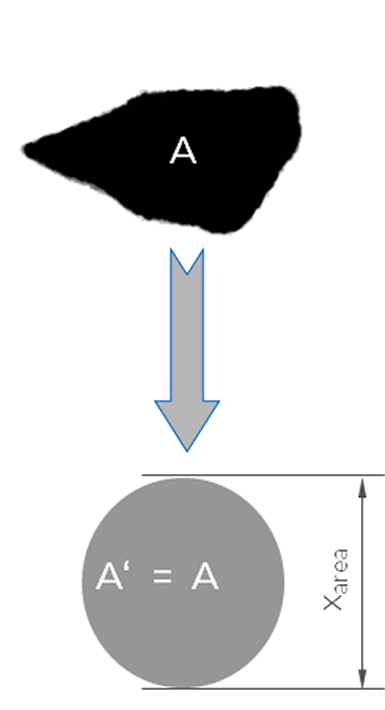
xarea
"Diameter of circle with same projection area"
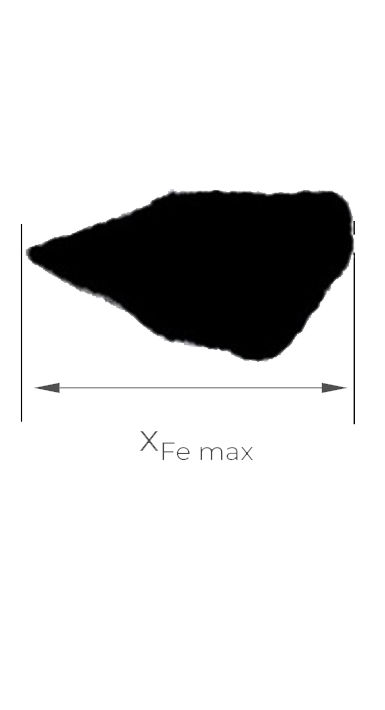
xFe max
"Length"

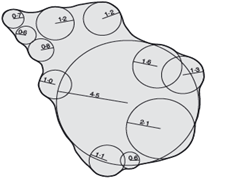
Roundness RDNS_C means radius of the corners divided by the radius of the inner circle
MICROTRAC Termékek & Kapcsolat
A Microtrac cég dinamikus képfeldolgozás elvén működő többféle analizátort is kínál.

Munkatársaink szívesen adnak tanácsot készülékeinkről és alkalmazási lehetőségeikről.