




Particle Size and Shape Analysis for Construction Materials
Cement, sands, aggregates, fillers, glass beads, fibers and hardened cementitious materials all depend on particle properties that can affect processing and final performance. Particle size distribution, morphology, surface area and pore structure influence cement hydration, material handling, packing, workability, compaction and the long-term behavior of construction products.
MICROTRAC provides particle analysis for construction materials across fine powders, coarse and irregular particles, suspensions and porous solids. These complementary measurements support raw-material qualification, production quality control, formulation development and the investigation of hardened materials.
A construction-material characterization strategy therefore needs to match the measurement to both the material state and the performance question - from cement particle size analysis during grinding and blending to aggregate size and shape analysis, admixture dispersion studies and cement pore structure analysis after hardening.

How Does Particle Analysis Support Construction Material Quality?
Particle analysis helps construction material laboratories compare raw materials, control production, and investigate hardened products. Size, shape, surface area, pores, density, and suspension behavior address different quality questions. Select the measurements around the material state and the property that needs to be understood or controlled.
- Control cement and filler fineness for consistent processing and hydration behavior
- Quantify the size and morphology of sands, aggregates, granules, glass beads and fibers
- Detect oversize or undersize fractions in broad or blended particle distributions
- Compare incoming raw materials and maintain building materials quality control between batches
- Investigate flocculation, sedimentation and the response of slurries to dispersing agents or admixtures
- Measure specific surface area, pore volume and pore-size distribution in cementitious and porous materials
- Connect hardened pore structure and density with strength, permeability and durability-related behavior
- Compare carbonation behavior under controlled test conditions
The goal is not to apply every technique to every material. It is to select the measurements that explain the property being controlled and combine them where size alone cannot provide enough information.
How Can Cement Particle Size Analysis Support Process Consistency?
Cement particle size analysis compares fineness between batches and shows changes introduced by grinding or blending. Laser diffraction measures size distributions of dispersed cement, mineral powders, and fillers, while particle images add information about coarse particles and agglomerates when distributions are broad or morphology matters.
How Does MICROTRAC's SYNC Combine Laser Diffraction and Imaging?
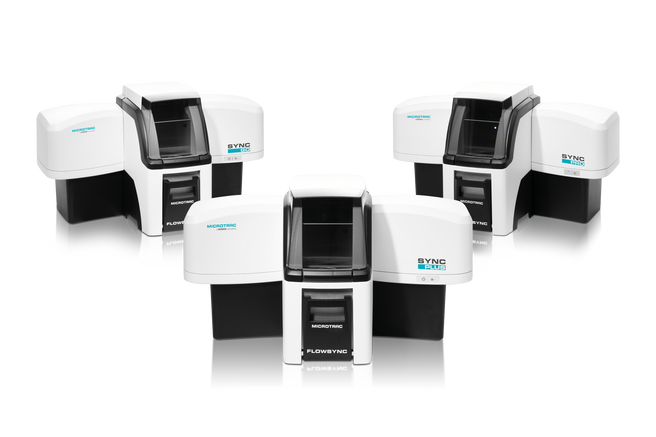
The SYNC series, consisting of the models SYNC GO, SYNC PLUS, and SYNC PRO, measures particle size distributions by laser diffraction in dry or compatible wet dispersions. With the optional camera, the SYNC analyzer adds dynamic image analysis for individual particle images and shape information, which helps investigate coarse particles and agglomerates.
- Measure cement powders, fillers, and blends
- Compare raw-material lots and production batches
- Investigate coarse particles and agglomerates
The SYNC series suits laboratories comparing dispersed cement, mineral powders, and fillers; cement requires dry dispersion or a compatible carrier liquid, and pore structure or skeleton density needs a dedicated method.
Why Measure the Size and Shape of Sands, Gravel, Glass Beads, and Fibers?
Particle shape complements size measurements when sands, aggregates, gravel, glass beads, or fibers have irregular or elongated forms. Width, length, roundness, and aspect ratio describe differences that a sieve result or size distribution alone may conceal, so dynamic image analysis supports quality control and development.
How Does MICROTRAC's CAMSIZER Series Quantify Particle Size and Morphology?
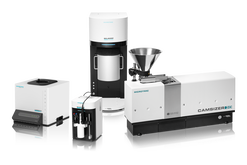
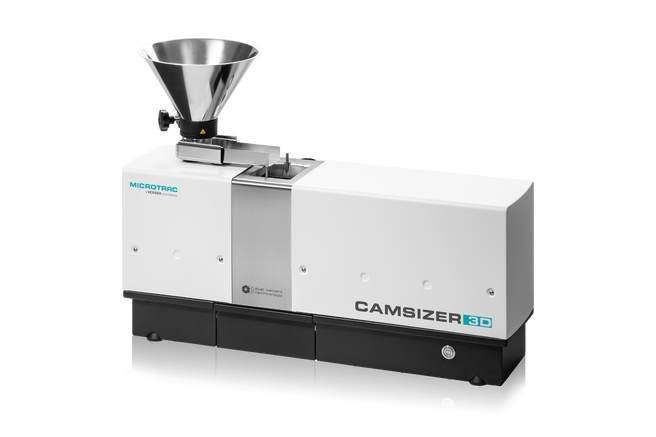
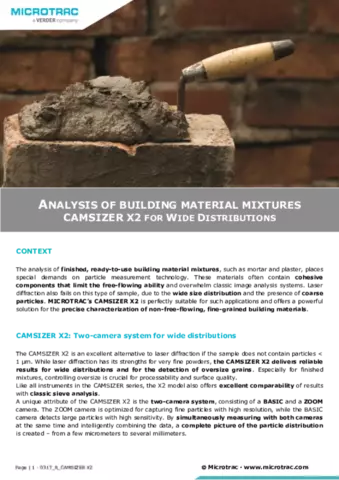
MICROTRAC's CAMSIZER instruments measure individual particles by dynamic image analysis and calculate size and shape distributions. The CAMSIZER 3D addresses dry, free-flowing materials; the CAMSIZER X2+ supports powders and cohesive mixtures with appropriate dispersion.
- Measure length, width, aspect ratio, and roundness
- Suitable for testing raw materials and finished building material mixtures
- Replace sieve analysis
The CAMSIZER series suits laboratories investigating particle dimensions and shape; internal pores and specific surface area need a complementary method such as gas adsorption.
Why Measure Surface Area and Pore Structure in Cementitious Materials?
Specific surface area and pore structure describe construction powders and porous materials beyond their external particle dimensions. These properties can influence reactivity, water demand, adsorption behavior, and permeability. Gas adsorption characterizes accessible surfaces and fine pores in suitable cements, fillers, and porous ingredients.
How Does MICROTRAC's BELSORP Series Measure Surface Area and Fine Pores?
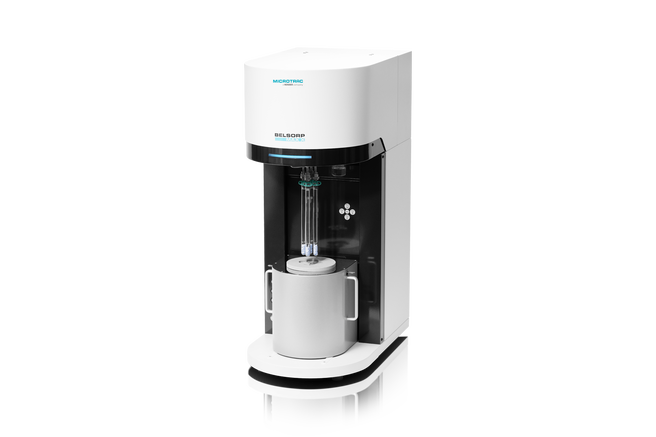
MICROTRAC's BELSORP analyzers, including the BELSORP MINI X, BELSORP MAX G, and BELSORP MAX X, measure gas adsorption isotherms for specific surface area and pore analysis. The adsorptive gas, pretreatment, and evaluation model are selected for the material.
- Compare cements, pozzolans, fillers, and lightweight aggregates
- Investigate differences affecting reactivity and liquid demand
- Characterize fine pores in porous materials
The BELSORP series suits laboratories investigating gas-accessible surface area and pore structure; particle size or external shape needs laser diffraction or dynamic image analysis.
How Can the Pore Structure of Hardened Cement Be Characterized?
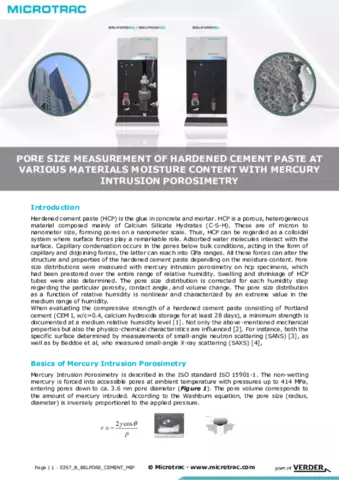
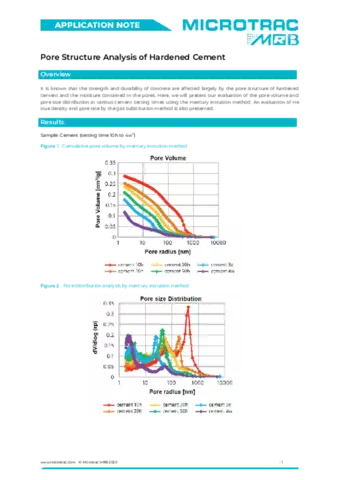
Pore structure becomes particularly important in hardened cement when mechanical performance, transport behavior, and durability are investigated. Mercury intrusion porosimetry evaluates accessible pore entry sizes and intruded volume, which supports comparisons of cement paste between formulations, curing conditions, or moisture conditions.
How Do MICROTRAC's BELPORE Analyzers Characterize Hardened Cement Pores?
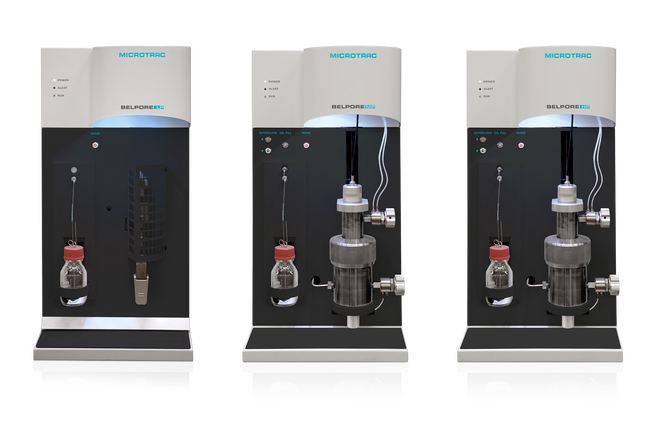
The BELPORE series by MICROTRAC measures mercury intrusion to evaluate accessible pore entry sizes and pore volume in porous solids, including hardened cement paste. Sample conditioning, controlled degassing, and pressure settings must be defined, particularly when moisture-dependent pore structure is investigated.
- Measure pore-size distribution in hardened paste
- Compare pores under different moisture conditions
- Compare formulations and curing-related differences
The BELPORE series suits comparative studies of accessible pore entry sizes and pore volume; permeability and durability require separate performance tests.
Why Measure the Skeleton Density of Cementitious Materials?
Skeleton density, determined by gas displacement, describes a different property from bulk density and particle packing. Combined with pore-volume data from mercury intrusion, it supports porosity evaluation of powders and hardened cement at defined stages of hydration or conditioning, provided the calculation basis is defined.
How Does MICROTRAC's BELPYCNO Add Density Information?
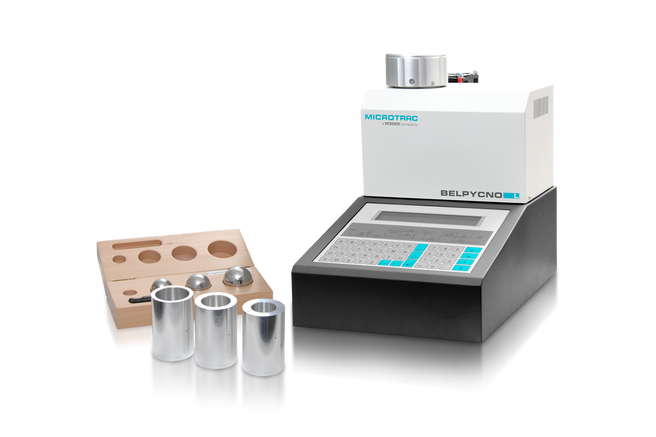
The BELPYCNO density analyzer by MICROTRAC uses gas displacement to determine skeleton density in powders and porous materials. For cementitious solids, the results complement mercury intrusion with the BELPORE and support porosity calculations when the sample condition and calculation basis are defined.
- Compare density at defined hydration stages
- Investigate density changes during cement setting
- Support porosity calculations with pore-volume data
The BELPYCNO suits laboratories determining skeleton density by gas displacement; bulk density and packing behavior need a separate procedure.
How Can Accelerated Carbonation Studies Support Concrete and Cement Research?
Accelerated carbonation studies examine how hydrated cementitious materials interact with carbon dioxide under controlled conditions. The measurements compare formulations and investigate the effects of humidity or sample preparation. Relating accelerated laboratory results to the durability of concrete requires appropriate interpretation and validation.
How Does MICROTRAC's BELCAT II Investigate Carbon Dioxide Interaction?
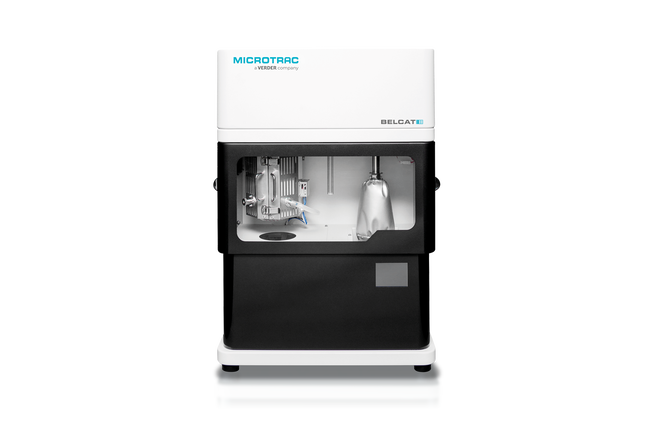
The BELCAT II catalyst analyzer, coupled with MICROTRAC's BELMASS II quadrupole mass spectrometer in the published concrete application, monitors gas interaction during accelerated carbonation of prepared cement samples. Temperature, relative humidity, and gas composition are part of the experimental arrangement and must be specified.
- Compare carbonation between cement formulations
- Investigate how humidity changes reaction behavior
- Evaluate CO2 uptake over accelerated test periods
The BELCAT II suits controlled gas-interaction experiments such as the published carbonation study; service-life prediction of an intact concrete structure requires appropriate durability assessment.
How Can Particle Interactions Affect Construction Suspensions and Admixtures?
Particles in cement slurries, filler dispersions, pigments, and admixture systems can flocculate, settle, or respond to changes in dispersing conditions. Zeta potential describes the charge-related part of this behavior and shows how dispersing agents, pH, or salts change particle interactions once the powder is dispersed.
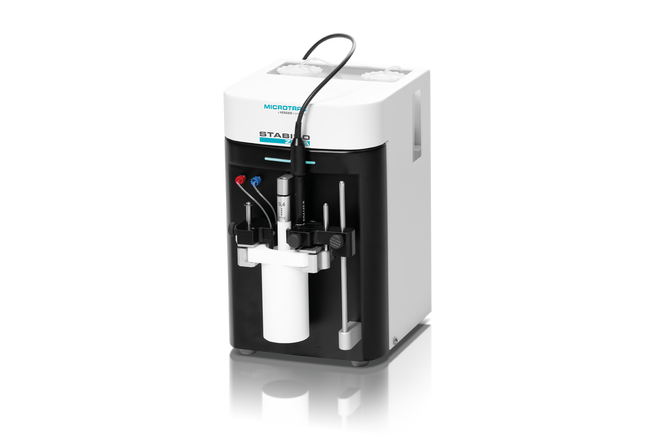
How Does MICROTRAC's STABINO ZETA Analyze Particle Interactions?
MICROTRAC's STABINO ZETA measures zeta potential with a streaming-potential approach and supports titration studies. In suitable construction dispersions, the measurements show the response to pH, salts, or dispersing agents; reactive cement-containing samples need a procedure confirmed with MICROTRAC application specialists.
- Evaluate dispersing agents and admixture conditions
- Investigate flocculation or coagulation tendencies
- Support work on flow and suspension uniformity
The STABINO ZETA suits charge-related studies in compatible dispersions; physical stability, workability, and setting require complementary measurements.
How Can Destabilization of Construction Suspensions Be Monitored?
Mineral slurries, pigment dispersions, and admixture systems can settle or aggregate over time. Static multiple light scattering follows these changes through the sample height, so construction formulation laboratories can compare destabilization under matched test conditions without relying only on long visual shelf tests.
How Does MICROTRAC's TURBISCAN Series Detect Suspension Destabilization?
MICROTRAC's TURBISCAN series uses static multiple light scattering to follow transmission and backscattering profiles through a sample over time. Changes in the optical profiles show particle migration and size-related changes in suitable concentrated suspensions.
- Compare mineral and pigment slurries
- Monitor sedimentation and aggregation
- Assess admixture formulation changes
The TURBISCAN series suits comparisons of physical destabilization over time; zeta potential and charge-related behavior need a complementary method such as the STABINO ZETA.
Which Analytical Technique Suits Each Construction Material?
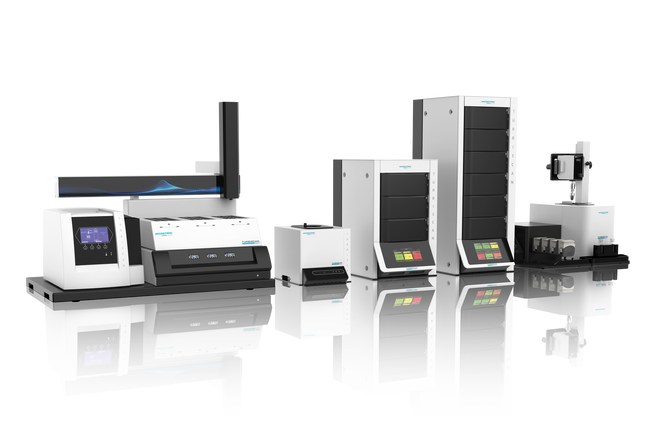
Select the analytical technique by the material state and the property being investigated. MICROTRAC provides complementary methods for powder sizing, particle morphology, surface area, pores, density, gas interaction, and suspension behavior. The product links below help identify relevant approaches for construction materials and provide access to detailed product information.
| Your Measurement Question | MICROTRAC’s First Choice | What to Keep in Mind |
| Size distribution of cement, mineral powders, and fillers, with optional particle images | SYNC Series – Laser Diffraction + Dynamic Image Analysis | Imaging requires the optional camera; cement requires dry dispersion or a compatible carrier liquid. |
| Size and shape of sands, aggregates, gravel, glass beads, and fibers | CAMSIZER Series – Dynamic Image Analysis | Select the model and dispersion for the sample; particle images do not show internal pores or gas-accessible surfaces. |
| Specific surface area and fine pores of cements, pozzolans, and fillers | BELSORP Series – Gas Adsorption | Select the adsorptive gas, pretreatment, and evaluation model; gas adsorption does not measure particle size or shape. |
| Accessible pore entry sizes and pore volume in hardened cement paste | BELPORE Series – Mercury Intrusion Porosimetry | Define conditioning, degassing, and pressure settings; mercury intrusion does not directly measure permeability or durability. |
| Skeleton density of powders and porous cementitious solids | BELPYCNO – Helium Gas Pycnometry | Different from bulk density and particle packing. |
| Gas interaction in accelerated carbonation studies | BELCAT II – Gas Interaction and Temperature-Programmed Analysis | Accelerated laboratory results do not directly predict the service life of a concrete structure. |
| Charge-related behavior in suitable cement, filler, and admixture dispersions | STABINO ZETA – Zeta Potential | Confirm the procedure for reactive cement-containing samples; zeta potential does not establish physical stability. |
| Sedimentation and destabilization of construction suspensions | TURBISCAN Series – Direct Stability Analysis | Measures physical stability over time, not zeta potential or charge-related behavior. |
Know Which Instrument Fits Your Lab?

Which Construction Material Applications Can MICROTRAC Support?
MICROTRAC supports construction material applications involving powders, granular mixtures, fibers, porous solids, and suitable liquid dispersions. The analytical question determines whether size, shape, surface area, pore structure, density, gas interaction, or suspension behavior is needed. The examples below connect these properties with quality control and material development tasks.
- Cement particle size analysis and grinding-control comparisons
- Aggregate size and shape analysis for sand, gravel, and chippings used in concrete, mortar, and road construction
- Quality control of glass beads, roof-shingle granules and other specialty particles
- Morphology assessment of natural and engineered fibers
- Building materials quality control across incoming raw materials and production batches
- Specific surface area and porosity analysis of cements, pozzolans and lightweight aggregates
- Cement pore structure analysis in hardened paste and porous materials
- Skeleton density and porosity evaluation during cement hydration
- Accelerated carbonation studies of concrete and hydrated cement materials
- Zeta potential studies in suitable cement, filler, or admixture dispersions
- Sedimentation, flocculation and dispersion-stability testing in construction suspensions
- Particle size analysis of gypsum and lime powders for plaster and wallboard
- Grading and fines assessment of recycled concrete and crushed brick
- Characterization of porous lightweight ingredients such as expanded clay and perlite
- Particle size and shape analysis of dry-mix mortar components for flowability, mixability, and water demand
- Particle size and specific surface area analysis of mineral additives such as fly ash, blast-furnace slag, silica fume, and limestone powder
- Pore structure characterization of aerated concrete and insulating materials
Not sure which method fits your material? MICROTRAC application specialists recommend a suitable method and instrument and discuss whether a measurement on your actual sample helps the decision.
Which Application Notes Support Construction Material Analysis?
MICROTRAC application notes provide examples for cement powders, broad building mixtures, sands, granules, fibers, hardened cement pores, carbonation, and particle interactions. Match each report to the material and measurement objective.

Cement: Laser Diffraction Analysis
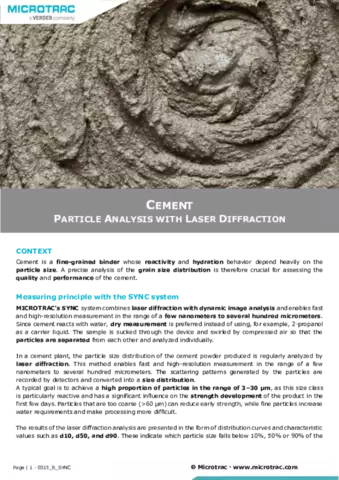
Particle Analysis of Cement with laser diffraction (Instrument: S3500).
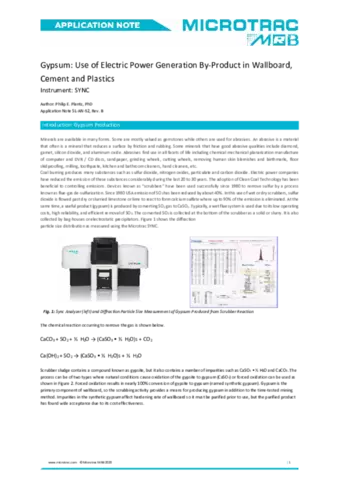
Gypsum: Electric Power Generation By-Product
MICROTRAC SYNC measurements of power-generation by-products.

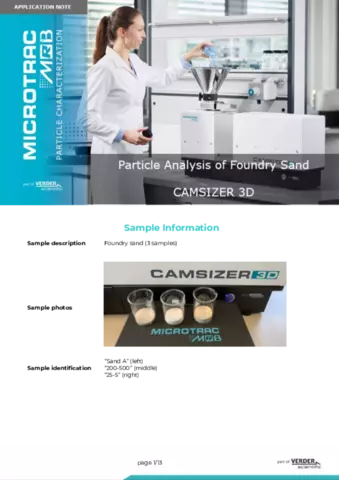
Particle Analysis of Foundry Sand
The Camsizer 3D allows fast and reliable characterization of foundry sand. The results are 100% compatible with traditional sieve analysis with a measurement time of less than 5 minutes and no cleaning or maintenance required.
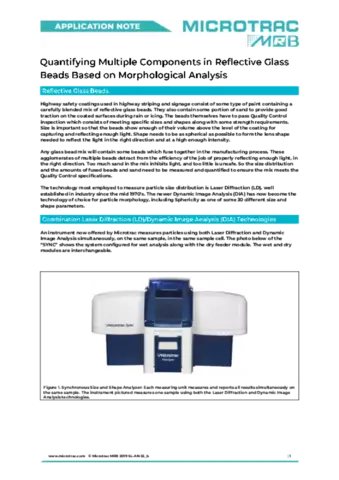

Roof Shingle Granules
Replacing Sieve Analysis with 3D Dynamic Imaging Technology: Roofing Shingle Granules Application Example






How Can MICROTRAC Help Characterize Your Construction Materials?
MICROTRAC application specialists can help select measurements for fine powders, coarse particles, suspensions, and hardened porous construction materials. Describe the sample state, expected size range, and the quality or development question. The required information determines which particle, surface, pore, density, stability, or gas-interaction measurement is appropriate.
Share these details with a MICROTRAC specialist to start the discussion.